Harness my what energy, you may ask? Underdog, so like Rocky, right? Yeah, kind of, but with fewer punches and less Adrian (nothing personal against Adrian).
Underdog energy is a term that’s been flying around a lot at Edna recently. I don’t know if we can claim to have ‘invented it’, or if that even matters. Born from some internal strategic work we’ve been doing, looking at a way to describe the type of brands that really excite us and we love working with.
So, what the hell does it mean? Well, rather conveniently, we’ve gone ahead and written the underdog energy manifesto, and who doesn’t love a manifesto:
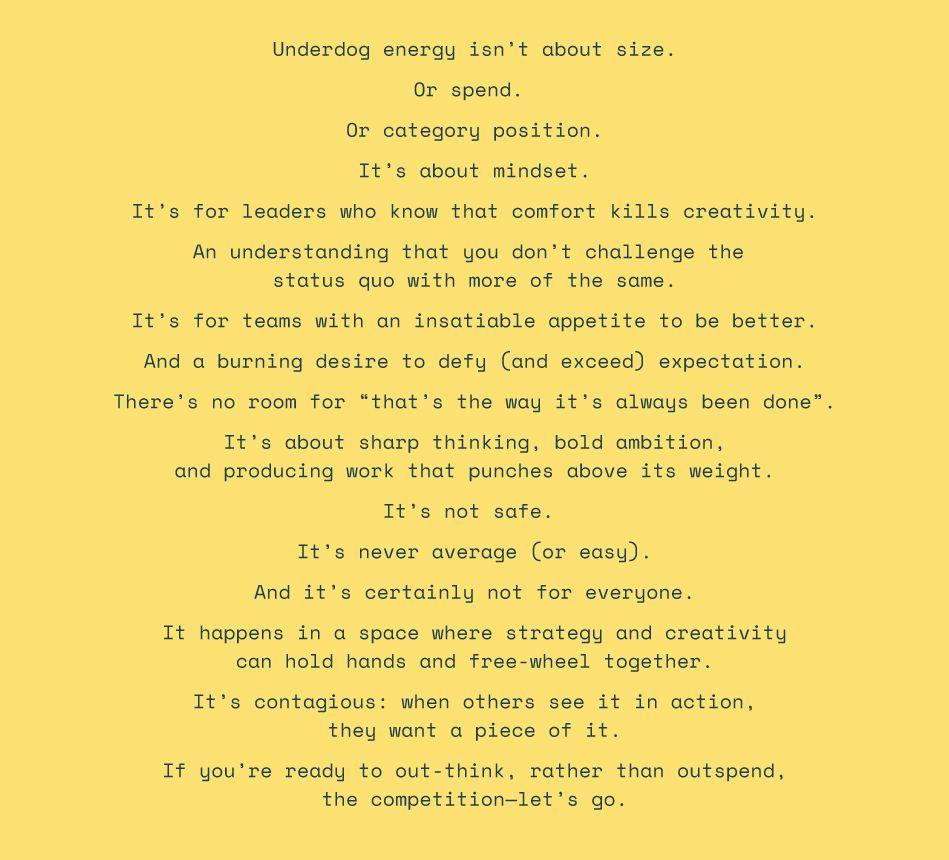
Well, they say it takes one to know one... as a creative agency, we’re not for everyone, we punch (yes, just like Rocky) above our weight, and we’re not afraid to challenge the status quo.
Chances are, if you’ve made it this far (well done and thank you), all this is resonating with you. You’re in for a treat, we’ve only gone and compiled our top three underdog energy behaviors to help your brand harness that energy and turn it into your superpower.
We’re hard-wired to remember what’s different. Hedwig von Restorff, a German psychologist, demonstrated this in her 1933 study, which showed that an item that stands out from a group of similar items is more likely to be remembered than the items that blend in. If it feels like you’ve seen it before, chances are you have. And in branding, when you’re trying to stand out, that’s not a good thing.
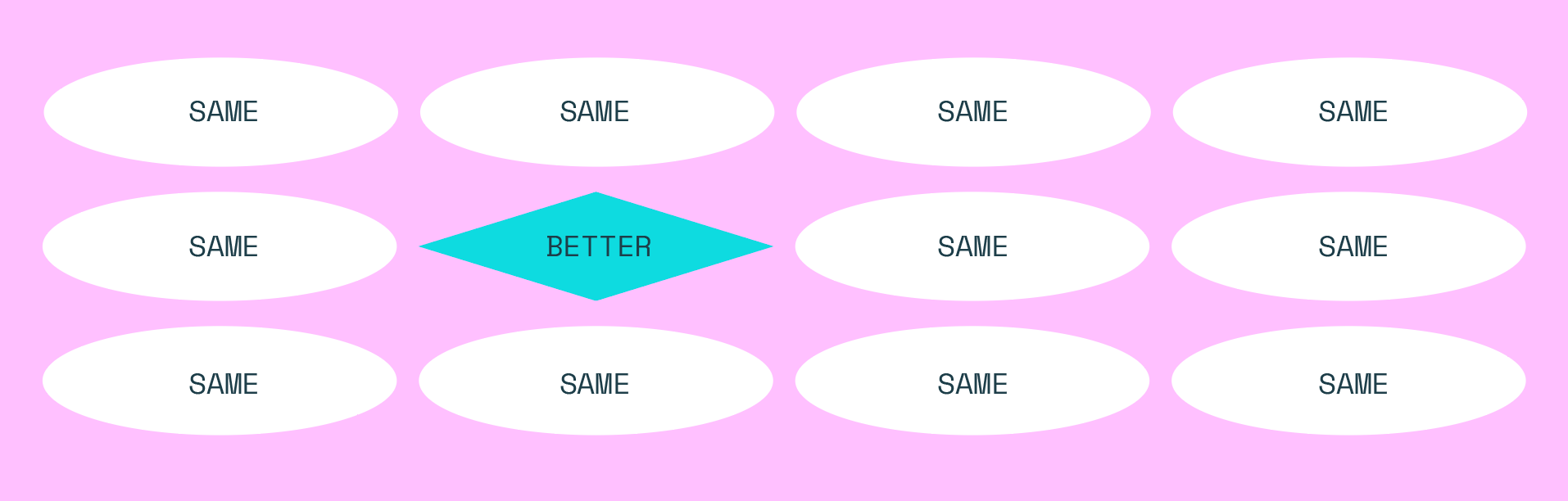
Being different for different’s sake isn’t the goal here, or the only consideration: different needs to be better as well. You still need to nail your positioning, cultural relevance, price-point etc. But for brands fighting their way up a category, going against the established aesthetic isn’t a guarantee that your product will get picked up from the shelf. But it gives you a fighting chance of being noticed by customers. And that’s the first step.
Satisfy blend punk and running in a way that doesn’t really make sense (£120 ’Moth-tech’ t-shirts with holes in), but it creates a totally different vibe, in stark contrast to the conservative aesthetic of most of the other running brands. The best part is that it’s authentic to them; their brand is an expression of the founders' aesthetic and interests.

Ok, I know brand consistency sounds boring, and distinctly not very underdog energy, but bear with me, it’s super important for brands of all types.
Brands are a multitude of associations in customers' minds built over time. More demands are put on modern consumers' attention than ever before; they need to recognise your brand quickly and easily. By being inconsistent in how you show up, you're making it harder for them to make these associations.
Traditionally, brands were built like grandiose cathedrals* of old – stoic, never changing, never moving. Today, the sheer number of channels, brands need to live on requires a different approach. Modern brands need to be more like tents*, firmly anchored in consistency, supported with a wider brand ecosystem system that allows them to move when they need to.
So, figure out what assets are your ‘tent pegs’ (your “distinctive brand assets”). Bang them in deep, so your customers can recognise you easily, but be sure to give yourself enough room to flex and move – this is where the creativity comes in.
What does this have to do with underdog energy? Established brands have built up huge brand equity in their assets. Don’t make it easy for them by being inconsistent with how you show up, letting them ‘muscle in’ on your customer's mental availability. Be proud of your brand's core ‘tent peg’ assets, get them in front of your customers often, but also invest in a wider brand system that allows you to show up with consistency, relevance, and creativity regardless of channel.
Full disclosure, I totally lifted the cathedrals and tents analogy from HERE.Erica writes some great stuff.
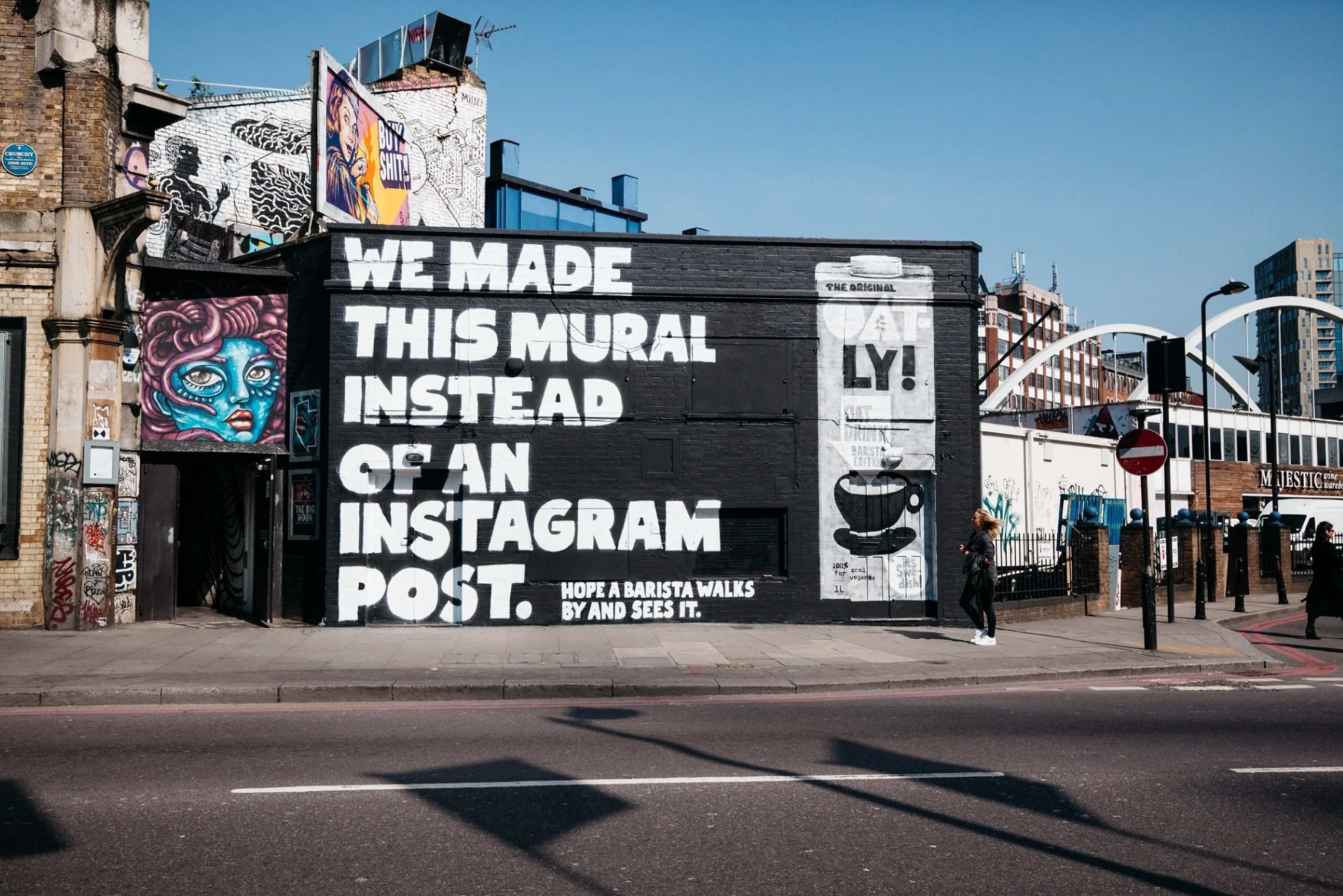
Underdog energy isn’t size-dependent, and Oatly has it running through their veins. They built their own visual code, established some really strong ownable assets, while giving themselves enough space to adapt and reflect culture. They’ve been so successful with their identity that they’ve given rise to several copycat competitors, look forward to seeing how far they push it to shake them off.
Thanks to the work of Les Binet and Peter Field, and more recently, System1, we know that brands (and creative) that provoke an emotional response in audiences are more likely to drive long-term brand growth.
Various cognitive studies have also shown that the emotional intensity at the time of the event increases recall strength. So, we’re more likely to remember the stuff that makes us feel something. Makes sense, right?
When we talk about an emotional response, it doesn’t have to be a story/narrative format. It can be, but it’s not the only option. We’ve heard that "people buy people”, and there’s some truth to that. So, rather than banging on repeatedly about the features of your product in your advertising and obsessing over optimisation, maybe talk about what your product enables people to do. How it makes them feel.
There’s a whole host of other factors to consider as well. But, as a brand, we’re normally trying to sell our customers something, so the least we can do is make them feel something, even if it's negative; it's better than nothing. And when you do, they’re more likely to remember you (and buy your products).
Ok, this is one of ours (I had to get at least one in here). As a new brand to the market, with some very established players, they needed a different approach to rise above the B2B ‘sea of sameness’. Our campaign leveraged a simple 'them vs us' construct: we paired unexpected objects to represent the pros of Motia and the cons of its competitors.
We tested the campaign with System1, and it scored exceptionally high on emotional response among our target audience. You don’t always have to tell your audience a story; just making them smile and showing you understand their challenges can be enough.
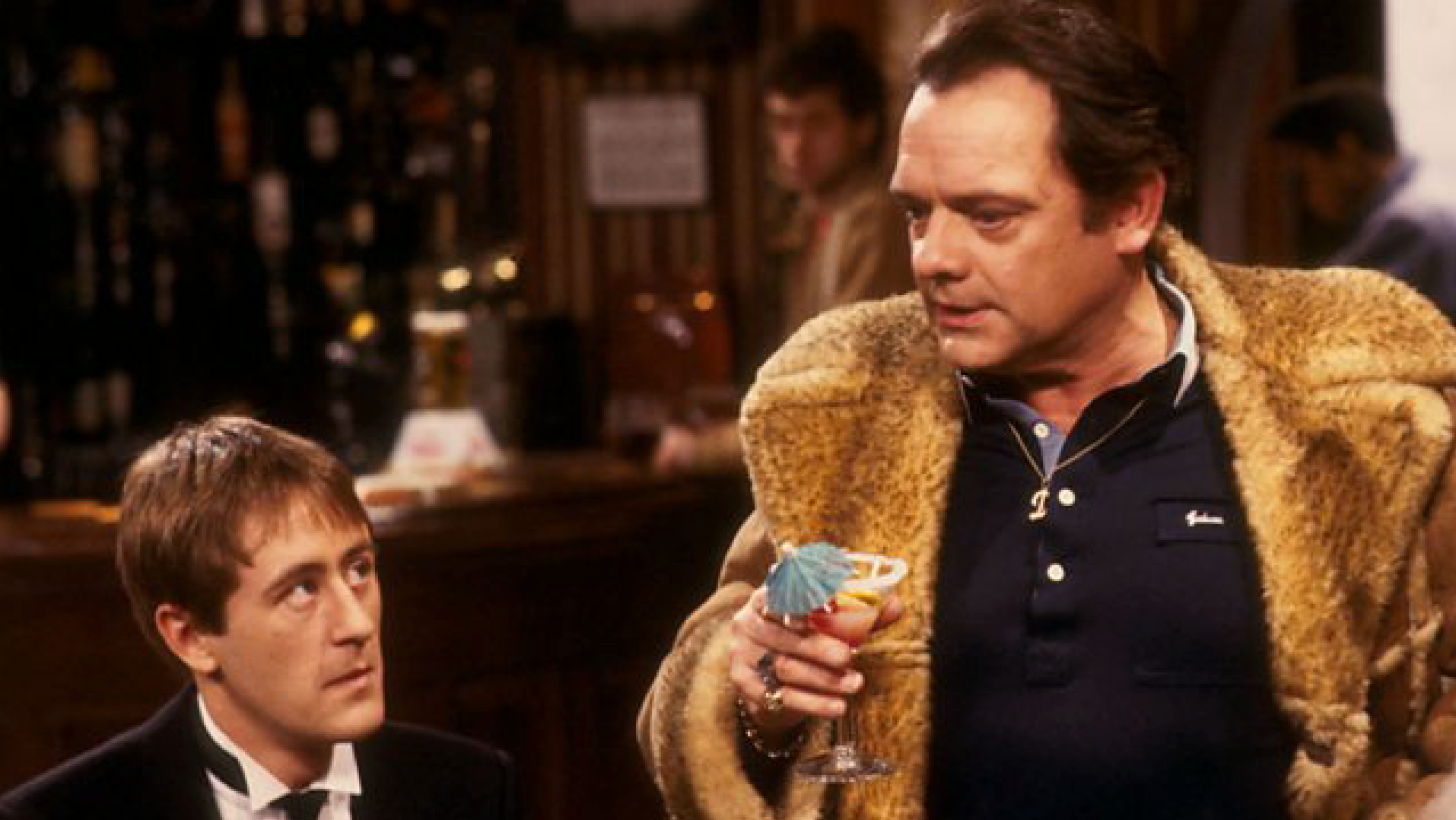
So, there you have it, do these three things, and this time next year you’ll be a millionaire (thanks, Del-boy). Of course, it’s not that simple. But they will help you focus that special energy your brand has and take the fight to the big boys, just like Rocky.
And if you’ve got a nice juicy brand challenge you’d like to discuss, give me a shout.
You can even bend my ear for half an hour (free of charge!) HERE.
https://thinkvia.be/wp-content/uploads/2025/09/System-1-and-Effie-The-Creative-Dividend.pdf?
https://www.frontiersin.org/journals/psychology/articles/10.3389/fpsyg.2017.01454/full
https://en.wikipedia.org/wiki/Von_Restorff_effect
